
Most articles about 'email builders for ecommerce' actually review email marketing platforms. These are different things — and confusing them leads to the wrong tool choice. This guide explains the distinction, then compares both categories on the criteria that matter for online stores.
Ecommerce email marketing is one of the highest-ROI channels available to online stores — email consistently generates $36–$45 for every $1 spent. But when store owners search for the best email builder for ecommerce, they encounter a market that conflates two fundamentally different types of tools: email builders and email platforms.
Getting this distinction right before choosing a tool is more valuable than any feature comparison. This guide explains the difference, identifies where each tool category excels, and gives specific recommendations by store size and need — including the combination that most experienced ecommerce email marketers actually use.
Email builder vs email platform: the distinction most articles miss
The most important decision in ecommerce email is not which tool to use — it is which type of tool to use. Every article about this topic lists the same tools (Klaviyo, Omnisend, Mailchimp) without explaining that these are email marketing platforms, not email builders. The distinction matters enormously in practice.
What an email builder is
An email builder is a design tool. Its job is to help you create professional, visually compelling email templates — using drag-and-drop editing, pre-built content blocks, and a template library — and export those templates to wherever you actually send email. Stripo is the leading standalone email builder. It does not send emails, manage subscriber lists, or track open rates. It designs the email, then hands it off.
The advantages of a standalone builder: deeper design capability, larger template library, better HTML output quality, and ESP portability — your templates can be pushed to any of 80+ sending platforms without rebuilding. When you switch ESPs (which growing ecommerce stores do regularly as their needs evolve), your design library comes with you.
What an email platform is
An email platform bundles the email builder with list management, segmentation, automation workflows, sending infrastructure, analytics, and revenue attribution in a single product. Klaviyo, Omnisend, Mailchimp, and ActiveCampaign are email platforms. Their built-in builders are functional but not the primary differentiator — the value is in the automation logic, the data integration with your store, and the behavioral triggers.
The trade-off: the builder inside an email platform is almost always less capable than a dedicated standalone builder. Templates are locked to the platform. If you switch from Mailchimp to Klaviyo, you rebuild your templates. The design depth, template variety, and smart element support are secondary concerns for platforms that focus primarily on data and automation.
|
The combination that experienced ecommerce email marketers actually use Stripo (design layer) + Klaviyo or Omnisend (automation and sending layer). Design your templates in Stripo — with access to 1,500+ ecommerce templates, AMP add-to-cart blocks, countdown timers, and product modules — then push them to Klaviyo or Omnisend with one click. You get the deepest email design available combined with the most capable ecommerce automation available. Neither alone achieves both. |
|
Email builder (Stripo) | Email platform (Klaviyo, Omnisend) |
|
|
Primary function |
Design templates | Design + send + automate + analyze |
|
Template portability |
90+ ESPs — switch freely | Locked to the platform |
|
Design depth |
1,500+ templates, AMP, smart elements | Functional but limited |
|
Automation |
Not included (use your ESP) | Core product feature |
|
Product data sync |
Manual or via ESP integration | Native store connection |
|
Pricing model |
Fixed ($15/month) regardless of list size | Scales with contact count |
|
Best for |
Design quality + ESP flexibility | All-in-one ecommerce automation |
Ecommerce email types: what you need to build
Before choosing a tool, it helps to understand exactly what types of emails an ecommerce store needs — and what design requirements each type has. This determines which features actually matter.
Abandoned cart emails
The highest-priority automation for any ecommerce store. Approximately 70% of shopping carts are abandoned before purchase. A well-designed abandoned cart sequence — typically three emails over 24–72 hours — uses urgency, social proof, and product imagery to bring shoppers back. Design requirements: prominent product images, dynamic product name and price pulled from the cart, a clear CTA, and optionally a discount offer in email three.
Stripo's abandoned cart templates handle the design layer — product image blocks, urgency copy, CTA buttons. The dynamic product data (actual product name, image, and price from the specific abandoned cart) is populated by your ESP (Klaviyo, Omnisend, or Mailchimp) using merge tags and store integration.
Post-purchase and upsell emails
Order confirmation, shipping notification, delivery confirmation, and post-purchase upsell sequences collectively have the highest open rates in ecommerce email — often 70–80%, because recipients are actively waiting for the information. These emails are both transactional (required for the customer experience) and commercial (an opportunity to recommend related products, collect reviews, and cross-sell).
Design requirements: clean, branded layout with clear order information, a product recommendation block for upsell, and a review request CTA. Stripo's transactional email templates provide the visual foundation; the actual order data and product recommendations are populated by the sending platform or transactional email service.
Promotional and flash sale emails
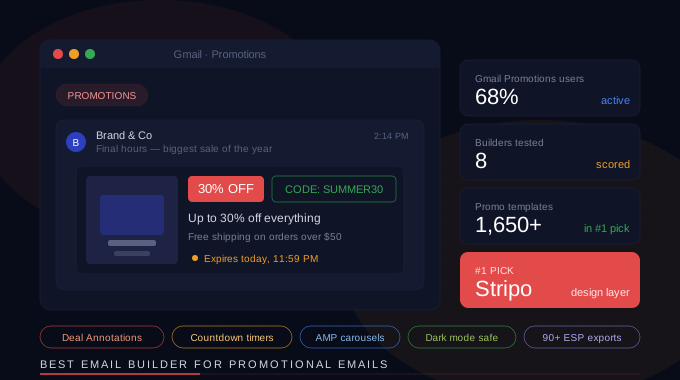
Time-limited promotions, product launches, seasonal campaigns, and flash sales are the highest-volume email type for most ecommerce stores. Design requirements: hero image, compelling headline, urgency element (countdown timer), product showcase blocks, and a prominent discount CTA.
This is where Stripo's ecommerce template library and countdown timer blocks provide the most direct value. The 1,500+ template library includes dedicated promotional and seasonal templates for every major sales occasion — Black Friday, Cyber Monday, seasonal clearances, product launches — organized by industry and campaign type. Countdown timers are configurable to any end date and time, creating real-time urgency directly in the email.
Win-back and re-engagement emails
Customers who have not purchased in 90–180 days represent both a revenue opportunity and a deliverability risk — inactive subscribers suppress open rates and damage sender reputation. Win-back sequences identify lapsed customers and attempt re-engagement through special offers, new product showcases, or 'we miss you' messaging.
Design requirements: personalized subject line, emotionally resonant copy, a compelling offer, and clean CTA. These emails benefit from high design quality because the reader's engagement threshold has already risen — a professional, visually compelling email is more likely to re-activate than a generic one.
Must-have ecommerce email features: the design checklist
These are the specific features that determine whether an email builder or platform is genuinely ecommerce-ready — not just claiming to be.
Product blocks and feeds
Ecommerce emails require product showcase blocks — image, name, price, and buy button — that can be populated with real product data. In a standalone builder like Stripo, product blocks are designed visually and the dynamic data (actual product name, image URL, and price) is inserted by the sending platform via merge tags. In native ecommerce platforms like Klaviyo, product blocks connect directly to the store catalog and pull product data automatically.
Stripo's product block modules provide the visual shell — clean, professional product cards — that work with any ESP's merge tag system. For stores using Klaviyo or Omnisend, the combination of Stripo's design layer and the platform's native product data sync produces the best result.
Countdown timers for flash sales
Real-time countdown timers in email — showing hours, minutes, and seconds until a sale ends — create genuine urgency that increases conversion rates on promotional campaigns. Stripo includes a visual countdown timer block that is configurable to any date and time without coding. This is a native feature, not a third-party embed — it generates the correct HTML directly in the exported email.
AMP add-to-cart in Gmail
Gmail's AMP for Email protocol allows recipients to add products to their cart, submit forms, and browse product carousels directly inside the Gmail inbox — without clicking through to the store. For ecommerce brands whose audiences are Gmail-heavy, AMP add-to-cart is a conversion rate opportunity that removes a friction point between email and purchase.
Stripo is the only visual email builder with native AMP for Email support. You build the AMP add-to-cart module visually — configuring the product, the CTA, and the cart integration — and Stripo generates both the AMP HTML (for Gmail) and a standard HTML fallback (for all other clients) automatically. No other visual builder in this comparison matches this capability.
Dynamic personalization
Personalized product recommendations — showing customers products based on their browse history, purchase history, or predictive algorithms — drive significantly higher click-through rates than generic product showcases. Dynamic personalization is primarily a platform feature (Klaviyo's predictive analytics, Omnisend's product recommendations) rather than a builder feature. However, the quality of the block design that displays these recommendations matters — and Stripo's product card modules provide the cleanest visual container for dynamic product data.
|
The AMP advantage for ecommerce AMP for Email allows recipients to complete a purchase action — adding to cart, selecting a variant, applying a coupon — directly inside Gmail without visiting the store. Removing the click-through step eliminates a major conversion friction point. Stripo's AMP editor makes this buildable visually, without writing AMP markup. For ecommerce brands sending to Gmail-heavy audiences, this feature alone can meaningfully improve campaign conversion rates. |
Best email builder for ecommerce: scored comparison
Each tool is scored on the five criteria that matter most for ecommerce email: design quality, ecommerce template depth, product block support, platform integration, and automation capability.
|
Tool |
Design |
Ecom templates |
Product blocks |
Integrations |
Automation |
Best for |
|
Stripo |
5/5 |
5/5 |
4/5 |
5/5 |
N/A* |
Design layer for any stack |
|
Klaviyo |
3/5 |
4/5 |
5/5 |
5/5 |
5/5 |
Best all-in-one platform |
|
Omnisend |
3/5 |
4/5 |
4/5 |
4/5 |
4/5 |
Mid-market ecommerce |
|
Mailchimp |
3/5 |
3/5 |
3/5 |
4/5 |
3/5 |
Entry-level stores |
|
ActiveCampaign |
3/5 |
3/5 |
3/5 |
4/5 |
5/5 |
Complex automation + CRM |
|
Brevo |
3/5 |
3/5 |
3/5 |
3/5 |
3/5 |
Budget ecommerce |
|
Beefree |
5/5 |
3/5 |
3/5 |
3/5 |
N/A* |
Design-only alternative |
|
GetResponse |
3/5 |
3/5 |
3/5 |
4/5 |
4/5 |
Funnels + ecommerce |
* Standalone builders (Stripo, Beefree) do not include sending or automation — these are handled by the connected ESP. N/A reflects this architectural difference, not a limitation.
The 8 best ecommerce email tools: full breakdown
1. Stripo — best email builder for ecommerce design
Stripo is the answer to the email builder half of the question. As a standalone design tool, it produces higher-quality ecommerce email templates than any bundled platform builder — with 1,500+ templates specifically organized by email type and industry (including dedicated sections for e-commerce, fashion, beauty, food and beverage, and seasonal campaigns), native AMP for Email support, countdown timer blocks, product card modules, and 80+ direct ESP integrations.
The core Stripo advantage for ecommerce is flexibility. Because Stripo is ESP-agnostic, your template library is portable. As your store grows from Mailchimp to Klaviyo to potentially Braze or Salesforce Marketing Cloud, your Stripo templates go with you with one click. The design investment compounds rather than being rebuilt with each platform switch.
Stripo does not replace an ecommerce email platform — it works alongside one. The recommended stack for most growing ecommerce stores is Stripo for design plus Klaviyo, Omnisend, or Mailchimp for automation and sending. This combination gives you the deepest design layer and the most capable automation layer simultaneously.
Best for: any ecommerce store that wants professional email design quality and ESP flexibility. Particularly valuable for stores that have already chosen their ecommerce email platform and want to upgrade the design quality of every template in that platform.
Pricing: Free (5 exports/month) — $15/month Personal — $45/month Team. Fixed pricing regardless of list size — unlike contact-based platform pricing that scales with store growth.
2. Klaviyo — best ecommerce email platform overall
If the question is specifically about all-in-one ecommerce email platforms, Klaviyo is the clear category leader. It syncs product catalogs, purchase history, and browsing behavior from Shopify, WooCommerce, and BigCommerce in real time. Predictive analytics — customer lifetime value, churn risk, expected next order date — are included on all plans. The 80+ pre-built flows cover every major ecommerce automation: abandoned cart, browse abandonment, post-purchase, win-back, back-in-stock, and price drop.
The built-in email editor is functional and no-code, but design depth is not Klaviyo's primary differentiator — data and automation are. Teams that want the highest-quality email design alongside Klaviyo's automation typically use Stripo as the design layer, pushing finished templates to Klaviyo for deployment.
Klaviyo's primary limitation for smaller stores is pricing. Contact-based pricing means costs scale directly with list growth — a meaningful consideration for fast-growing stores. At scale, the revenue attribution and automation ROI typically justify the cost.
Best for: established ecommerce stores that need the deepest Shopify or WooCommerce integration, behavioral automation, and predictive analytics. The benchmark for ecommerce email platforms.
Pricing: Free (250 contacts) — scales with list size. Competitive at low volumes, expensive at high volumes.
3. Omnisend — best mid-market ecommerce platform
Omnisend sits between Klaviyo's power and simpler builders' accessibility. It is designed specifically for ecommerce, with native Shopify, WooCommerce, and BigCommerce integrations. The product picker connects directly to the store catalog — select items, and Omnisend pulls images, descriptions, and prices automatically. Pre-built automation workflows cover the essential ecommerce flows, and SMS is included alongside email in a single unified platform.
For small to mid-sized ecommerce stores that want solid automation without Klaviyo's learning curve or pricing, Omnisend delivers strong value. The email builder is clean and capable. For teams that want to elevate their design quality beyond Omnisend's built-in builder, Stripo's Omnisend integration (one-click push) makes the combination straightforward.
Best for: small to mid-sized ecommerce stores wanting email + SMS in one platform at a more accessible price than Klaviyo, with solid ecommerce automation out of the box.
Pricing: Free (250 contacts, 500 sends/month) — from $16/month for 500 contacts.
4. Mailchimp — best entry-level ecommerce platform
Mailchimp's ecommerce functionality covers the basics well: Shopify and WooCommerce integrations, abandoned cart emails, product recommendation blocks, and purchase-triggered automations. For stores just beginning their email marketing program, Mailchimp's ecosystem — tutorials, integrations, brand recognition — reduces the barrier to getting started.
The limitations become apparent as stores scale: automation depth is less sophisticated than Klaviyo or Omnisend, ecommerce-specific segmentation is more limited, and the contact-based pricing increases quickly as lists grow. Many ecommerce brands start on Mailchimp and migrate to Klaviyo or Omnisend once their email program matures — which is when Stripo's ESP-portable templates become particularly valuable.
Best for: new ecommerce stores beginning their email program, particularly those already integrated with Shopify or running basic newsletter and abandoned cart campaigns.
Pricing: Free (500 contacts, 1,000 sends/month) — from $13/month.
5. ActiveCampaign — best for ecommerce stores needing CRM + email
ActiveCampaign is the strongest choice for ecommerce stores that also need B2B or wholesale CRM capability alongside their email marketing. The automation builder (135+ triggers, unlimited workflow steps) is more flexible than Mailchimp's and handles complex multi-branch sequences. Shopify, WooCommerce, and BigCommerce integrations support abandoned cart tracking and purchase-based automation.
The ecommerce-specific data sync is less deep than Klaviyo's — no real-time browsing data, no predictive CLV — but the CRM capability makes ActiveCampaign uniquely suitable for stores that manage both retail and wholesale customer relationships in one platform.
Best for: ecommerce stores with a significant B2B or wholesale component that need CRM deal pipelines alongside their consumer email marketing.
Pricing: From $15/month (Starter). Scales with contacts.
6. Brevo — best budget ecommerce email platform
Brevo offers a capable ecommerce email solution at the most accessible price in this comparison. The WooCommerce integration supports transactional and marketing emails in one platform. The free tier covers unlimited contacts at 300 emails per day, making it suitable for stores with large lists and moderate send frequency. SMS is included alongside email.
The ecommerce feature depth is more limited than Klaviyo or Omnisend — less sophisticated behavioral automation, fewer pre-built ecommerce flows, and more basic segmentation. For stores under approximately $50,000 in annual revenue that want email and SMS in one affordable platform without Klaviyo's complexity or cost, Brevo is a practical starting point.
Best for: early-stage ecommerce stores with tight budgets that want email and SMS in one platform and can work within more basic automation capabilities.
Pricing: Free (unlimited contacts, 300 emails/day) — from $25/month for 20,000 emails.
7. Beefree — best design-focused ecommerce builder alternative
Beefree is the strongest alternative to Stripo as a standalone email design tool for ecommerce. The editor is clean and polished, the HTML output is reliable across clients, and the free tier covers basic design needs. For ecommerce teams that prioritize visual quality and a clean interface over template depth and smart element support, Beefree is worth evaluating alongside Stripo.
The limitations relative to Stripo are meaningful for ecommerce specifically: no AMP for Email support (no add-to-cart blocks), no native countdown timer block, a smaller template library (around 80 vs 1,500+), and fewer direct ESP integrations (26 vs 80+). For ecommerce stores where AMP add-to-cart or countdown timers are important, Stripo is the stronger choice.
Best for: design-focused ecommerce teams that want the cleanest standalone editor interface and do not require AMP support or countdown timers.
Pricing: Free (3 exports/month) — from $30/month.
8. GetResponse — best for ecommerce funnels
GetResponse's primary ecommerce advantage is its sales funnel infrastructure — templated sequences of ads, landing pages, forms, and emails that guide customers from awareness to purchase. Integrations with Shopify, Magento, BigCommerce, and WooCommerce power purchase-triggered automations. Discount coupon generation and web push notifications add multichannel reach.
The email builder is functional but not the tool's primary strength. For ecommerce stores whose email marketing is part of a broader acquisition funnel — paid traffic, landing pages, email nurturing, purchase — GetResponse's unified funnel builder offers more than a standalone email tool.
Best for: ecommerce stores running paid traffic to landing pages who want the entire acquisition funnel — ads, pages, and email — in one platform.
Pricing: Free (500 contacts) — from $19/month.
Best ecommerce email tool by store size and maturity
The right ecommerce email tool depends heavily on where your store is in its growth journey. Here is how the recommendation changes by stage.
New ecommerce stores (under $10K monthly revenue)
Recommended stack: Mailchimp or Omnisend + Stripo free tier. New stores need to start email marketing quickly without over-investing in infrastructure they are not yet ready to use. Mailchimp or Omnisend handle the basic automation (welcome series, abandoned cart) at low or no cost. Stripo's free tier (5 exports/month) provides professional-quality templates without a monthly commitment. This stack costs as little as $0/month while producing emails that look significantly better than platform-native templates.
Growing ecommerce stores ($10K–$100K monthly revenue)
Recommended stack: Omnisend + Stripo Personal. Growing stores need reliable abandoned cart recovery, post-purchase sequences, and segmentation. Omnisend's ecommerce automation handles these flows at a more accessible price than Klaviyo. Stripo Personal ($15/month, unlimited exports) gives the design team the full template library and smart element support. Total cost: approximately $40–$80/month for the platform plus $15/month for design, delivering email quality that most stores at this level do not achieve.
Scaling ecommerce stores ($100K+ monthly revenue)
Recommended stack: Klaviyo + Stripo Team. At scale, the depth of Klaviyo's data integration — real-time behavioral triggers, predictive CLV, browse abandonment, back-in-stock — justifies the contact-based pricing. Stripo Team ($45/month) provides the collaborative design infrastructure for a team producing multiple campaigns per week. Revenue attribution in Klaviyo makes it easy to quantify the ROI of both the platform and the design investment.
Enterprise ecommerce
Recommended stack: Klaviyo or Braze + Stripo Enterprise. Enterprise stores need custom automation logic, advanced segmentation, dedicated infrastructure, and team governance. Klaviyo scales to this level without requiring engineering resources. Braze is the alternative for app-first or mobile-heavy commerce brands. Stripo's Enterprise plan adds white-label capability, custom API access, and dedicated support — serving as the design layer for complex, high-volume email programs.
Ecommerce automation flows: what to build first
Automation flows are where ecommerce email delivers the highest ROI — they run continuously without ongoing effort. Here is the priority order for setup, with design notes for each.
|
Automation |
Design priority & Stripo angle |
|
1. Abandoned cart (3 emails) |
Product image block + urgency headline + CTA. Email 3 adds discount. Stripo's abandoned cart templates cover all three stages. |
|
2. Welcome series (3–5 emails) |
Brand introduction + bestsellers + social proof. Stripo's welcome templates are organized by industry vertical. |
|
3. Post-purchase sequence |
Order confirmation + shipping + delivery + review request + upsell. Stripo's transactional templates provide the visual base. |
|
4. Browse abandonment |
Product image + back-in-stock urgency + CTA. Triggered by browsing without adding to cart. |
|
5. Win-back campaign |
Personalized subject + compelling offer + clean CTA. High design quality matters — reader engagement threshold is higher. |
|
6. Back-in-stock alert |
Product image + availability notification + urgency. Simple single-focus template. |
|
7. Price drop notification |
Product image + original vs new price comparison + CTA. Countdown timer optional if time-limited. |
Platform integrations: connecting design to ecommerce
The integration layer is what connects a design tool to an ecommerce store and its sending platform. Here is how Stripo's integration stack works for the most common ecommerce setups.
Shopify stores
Stripo integrates with Klaviyo, Omnisend, Mailchimp, and all major Shopify-compatible ESPs via one-click export. Design in Stripo, push to your Shopify-connected ESP, and the platform handles product data population and purchase-triggered automation. Stripo's Shopify-specific templates — product announcement, abandoned cart, seasonal promotion, and post-purchase — are optimized for the visual patterns that perform well in ecommerce email.
WooCommerce stores
WooCommerce stores typically use Klaviyo, Mailchimp, Brevo, or GetResponse as their email platform. All four are in Stripo's direct integration list. The workflow is identical: design in Stripo, export to your WooCommerce-connected platform, populate dynamic product data via the platform's merge tag system.
Custom or headless ecommerce
For stores on custom platforms or headless commerce architectures, Stripo's HTML export — clean, table-based, fully inline-CSS — can be imported into any transactional email service (SendGrid, Mailgun, Postmark) or ESP via the HTML import function. The exported code is platform-agnostic and requires no reformatting.
Pricing comparison for ecommerce email
Ecommerce email pricing is more complex than most markets because contact-based pricing means costs scale directly with store growth. Understanding the pricing model is as important as the monthly cost.
|
Tool |
Pricing model & ecommerce notes |
|
Stripo |
Fixed: Free → $15/month → $45/month. List size irrelevant — pricing does not scale with contact count. |
|
Klaviyo |
Contact-based. Free (250 contacts) → ~$45/month (1,000) → ~$150/month (5,000) → ~$400/month (15,000) |
|
Omnisend |
Contact-based. Free (250) → $16/month (500) → $59/month (2,500) → includes SMS credits |
|
Mailchimp |
Contact-based. Free (500) → $13/month (500) → $20/month (1,500) → $350/month (50,000) |
|
ActiveCampaign |
Contact-based. From $15/month (1,000 contacts). Scales with contacts and features |
|
Brevo |
Send-volume based. Free (300/day) → $25/month (20K sends). Unlimited contacts on all plans |
|
Beefree |
Fixed: Free (3 exports) → $30/month. Not an ESP — no list-size pricing |
|
GetResponse |
Contact-based. Free (500) → $19/month (1,000) → $59/month (10,000) |
|
The Stripo pricing advantage at scale Because Stripo's pricing is fixed (not contact-based), it becomes proportionally cheaper as your ecommerce store grows. At 500 contacts, $15/month for Stripo plus $16/month for Omnisend totals $31/month. At 50,000 contacts, $15/month for Stripo plus $350/month for Mailchimp totals $365/month — compared to $350/month for Mailchimp alone. The design layer essentially becomes free at scale. This fixed-cost architecture is particularly valuable for fast-growing ecommerce stores where contact count can double every quarter. |
Frequently asked questions: email builders for ecommerce
What is the best email builder for ecommerce?
The answer depends on whether you need a design tool or an all-in-one platform. For email design quality, Stripo is the best standalone email builder for ecommerce — with 1,500+ ecommerce templates, native AMP add-to-cart support, countdown timers, and one-click integration with 80+ ESPs including Klaviyo, Omnisend, and Mailchimp. For an all-in-one ecommerce email platform (builder + automation + sending + analytics), Klaviyo is the category leader. The combination most experienced ecommerce email marketers use is Stripo for design plus Klaviyo or Omnisend for automation.
Do I need a dedicated ecommerce email platform or a standalone builder?
Most ecommerce stores benefit from both — used together. A standalone builder like Stripo handles template design at a quality level that platform-native editors cannot match. An ecommerce email platform like Klaviyo or Omnisend handles the data integration, behavioral automation, and sending infrastructure that a design tool does not provide. The decision is not either/or: use Stripo as the design layer and your chosen platform as the automation and sending layer. New stores often start with just a platform (Mailchimp or Omnisend free tier) and add Stripo when design quality becomes a priority.
Does Stripo integrate with Shopify?
Stripo integrates with all major Shopify-compatible email platforms — Klaviyo, Omnisend, Mailchimp, ActiveCampaign, Brevo, and 75+ more — via direct one-click export. You design your email in Stripo, push it to your Shopify-connected ESP, and the platform handles product data population and automation triggering. Stripo also has a dedicated library of Shopify-optimized ecommerce templates covering abandoned cart, post-purchase, promotional, and seasonal campaigns.
Is Klaviyo worth the price for ecommerce?
For established ecommerce stores with meaningful email revenue, Klaviyo's pricing is typically justified by the revenue attribution it provides. Its predictive analytics, real-time behavioral triggers, and 80+ pre-built flows produce measurable revenue lift that contact-based pricing pricing can be evaluated against directly. For new or early-stage stores where email automation is simple (basic abandoned cart and welcome series), Omnisend or Mailchimp at lower cost provide sufficient capability until the store's email program matures.
What ecommerce email automations should I set up first?
Priority order by ROI: (1) Abandoned cart sequence — 3 emails over 24–72 hours, typically recovering 5–15% of abandoned carts. (2) Welcome series — 3–5 emails introducing the brand to new subscribers, building the relationship before the first purchase request. (3) Post-purchase sequence — order confirmation, shipping notification, delivery confirmation, review request, and upsell. (4) Browse abandonment — triggered by product view without add-to-cart. (5) Win-back campaign — targeting customers who have not purchased in 90–180 days. Set these five up before any other automation; they generate the highest ongoing revenue per hour of setup time.
Can I use Stripo with any ecommerce platform?
Yes. Stripo exports clean HTML that works with any email service provider or transactional email system. Direct one-click integrations cover 80+ platforms including all major ecommerce ESPs: Klaviyo, Omnisend, Mailchimp, ActiveCampaign, Brevo, GetResponse, Salesforce Marketing Cloud, HubSpot, Marketo, and many more. For platforms not in the direct integration list, Stripo's HTML export imports cleanly into any ESP's custom HTML editor. Because Stripo is ESP-agnostic, your template library remains yours regardless of which ecommerce platform or email service you use.
Final thoughts
The most important thing to take from this guide is the distinction between email builders and email platforms. Most articles blur this line and leave readers choosing the wrong category of tool. A standalone email builder like Stripo and an ecommerce email platform like Klaviyo or Omnisend are not competitors — they are complementary layers of the same stack.
For new stores: start with Mailchimp or Omnisend's free tier and Stripo's free tier. Get your basic automation running, build your first professional templates, and evaluate the combination with zero financial commitment.
For growing stores: Stripo Personal ($15/month) plus Omnisend provides the design quality and automation depth that most stores at this stage need, at a total cost that is easily justified by a single additional recovered abandoned cart per month.
For scaling stores: the Stripo plus Klaviyo combination is the stack that professional ecommerce email teams consistently arrive at when optimizing both design quality and automation capability. The design investment in Stripo is portable — it follows you as your platform stack evolves.


