


70–80% of Early Demand Is Never Searched: The Gap Between Market Conversations and Search Demand
For years, I thought SEO and keyword research were the ultimate way to find demand.
Do the research, optimize the content, watch the traffic grow. Simple.
Then I noticed a pattern that repeated across multiple markets:
by the time a keyword showed volume, the conversation had already happened elsewhere — weeks or even months earlier.
This is what I call early demand: the stage where people feel a problem, discuss it, but haven’t yet searched for it in Google.
Based on my observations, roughly 70–80% of this early demand never shows up in search data immediately — it emerges in forums, communities, and discussions before it becomes measurable.
Understanding the 70–80% Gap
Here’s how I noticed it:
-
Repeated problem discussions: Multiple people describe the same pain in different words across communities like Reddit (r/startups, r/SaaS, r/marketing), forums like Quora and StackExchange, and niche Facebook/LinkedIn groups.
-
No consistent search terminology: People don’t yet know how to name their problem, so they don’t Google it.
-
Gradual normalization: Only when language stabilizes and terms become shared does search volume appear.
The gap is real. Conversations predict search trends weeks or months before keyword tools catch up.
This isn’t anecdotal: it aligns with research on information-seeking behavior and the availability heuristic.
Additional sources for early demand signals include:
-
Quora: detailed questions about SaaS integrations, crypto wallets, or marketing automation
-
StackExchange: developers and marketers discussing features, bugs, and tools before search queries exist
-
Product Hunt discussions: early adopter feedback on products that later gain SEO volume
-
Twitter threads: users exploring pain points in niche verticals months before search trends appear
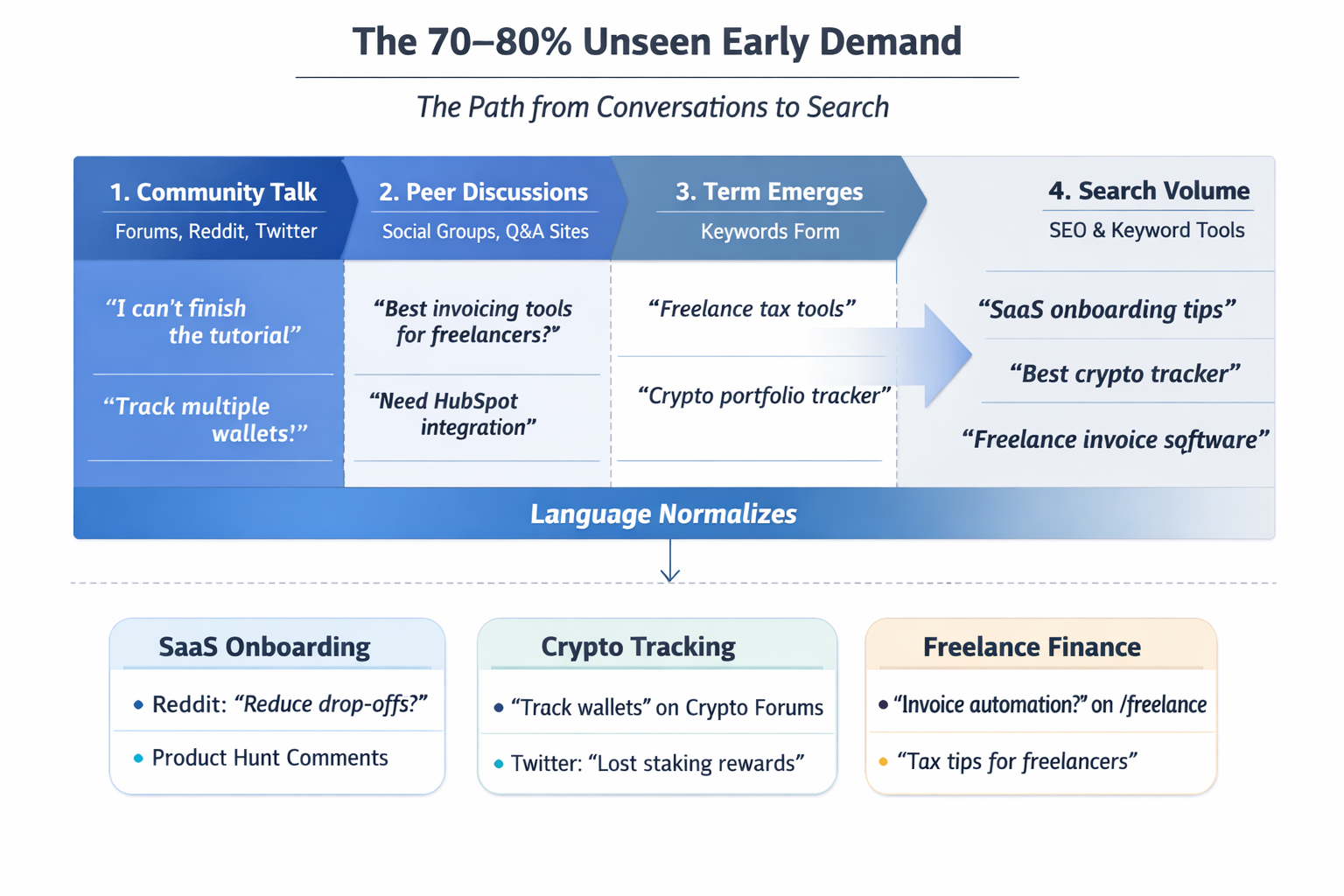
Examples of Early Demand People Often Miss
SaaS onboarding challenges
-
Early discussions: Users on r/SaaS and Product Hunt described difficulties with multi-step onboarding flows: “I can’t get my users to finish the tutorial” / “Any tips to reduce drop-offs in onboarding?”
-
Search appearance: “SaaS onboarding best practices” keywords showed up 2–3 months later.
-
Sources:
Crypto portfolio tracking
-
Early discussions: Users shared struggles managing multiple wallets or tracking yields: “How do you track multiple wallets efficiently?” / “I lost track of my staking rewards”
-
Search appearance: Keywords like “best crypto portfolio tracker” appeared 1–2 months later.
-
Sources:
Finance tools for freelancers
-
Early discussions: On r/freelance and r/personalfinance: “How do you manage invoices automatically?” / “Best tools to calculate taxes as a freelancer?”
-
Search appearance: “Freelance invoice tools” / “freelance tax software” 2–3 months later.
-
Sources:
Early SaaS feature requests
-
Early discussions: Users asking for product integrations or automation: “I need my SaaS app to connect with HubSpot automatically” / “How do you automate email sequences for onboarding?”
-
Search appearance: “Best HubSpot integration for SaaS” or “email automation onboarding” months later.
-
Sources:
Why Early Demand Matters
Most content strategies focus on keywords — essentially, they chase past demand.
But early demand is where real leverage lives:
| Stage | Where it appears | What it looks like |
|---|---|---|
| 1 | Communities, forums, social platforms | Vague complaints, repeated questions |
| 2 | Peer discussion | Comparison of experiences, frustration signals |
| 3 | Normalized language | Keywords emerge, searches begin |
| 4 | Search data | SEO-ready, measurable demand |
Notice that stages 1–2 cover roughly 70–80% of early demand — before any keyword shows significant volume.
Skipping these stages means entering markets late, writing generic content, and optimizing for demand already solved socially.
How I Started Noticing It
At first, I tracked everything manually: bookmarks, notes, memory.
Bias crept in — classic availability bias. I remembered what confirmed assumptions, ignored the rest.
Breakthrough came when I focused on patterns, not metrics:
-
Repeated questions phrased differently
-
Emotional markers: “anyone else struggling with…”, “I’m stuck”, “this feels wrong”
-
Long problem descriptions with no clear solution mentioned
When these signals repeated across multiple channels, I knew demand was forming, even if search data said otherwise.
Lessons I Learned
-
Search is reactive. Google and keyword tools reflect demand after it has stabilized.
-
Conversations are predictive. Early discussions reveal problems before they become searchable.
-
Monitoring is key. Forums, Reddit, Quora, StackExchange, Product Hunt, Twitter threads — all are raw market signals.
-
Discipline matters. Don’t rush to create content — observe until a pattern emerges.
Why This Insight Matters
Ignoring early demand leads to:
-
Entering markets late
-
Writing generic content
-
Optimizing for problems people have already solved socially
Shift your mindset: stop chasing keywords, start observing conversations.
That’s where real, high-leverage opportunities live.


